Basics of Income Tax for Beginners
Find the right expert, without the hassle.
Connect with verified professionals for tax, legal, and compliance needs.
If you have just started earning, income tax rules may feel a bit confusing and overwhelming.You will get to hear terms like ITR filing, slab rates, deductions etc. but no one clearly explains them.
This blog breaks down the basics of income tax for beginners (FY 2026–27) in a practical way so you can understand what you actually need to do and avoid costly mistakes.
What is Income Tax ?
Income tax is the amount you pay to the government on the income you earn during a financial year. In India this money is used for Defence and public services, healthcare and education, infrastructure (roads, railways etc). A portion of your income goes to the government based on the applicable slab rates.
Financial Year vs Assessment Year vs Tax Year (Updated for FY 2026–27)
Earlier there were two terms as per Income tax Act 1961:
Previous year
Assessment year
Previous year (PY)
The previous year is the same as the financial year. It is a period of 12 months from 1st April to 31st March. It is the period in which you earn your income. It doesn’t matter when you have started your job, the previous year ends on 31st March.
Example: You have started doing a job in July 2025, so your previous year will be 2025-26.
Assessment year (AY)
This is the financial year after the previous year. In this year you will assess your income and file return of the previous year.
Example: In case you have earned income during 2025-26(PY) , your assessment year will be 2026-27
Now, the government has simplified things by introducing the concept of a Tax Year.
What Is a Tax Year?
The Tax Year is simply the 12 month period in which you earn your income and for which you pay tax.
Example:
Tax Year 2026–27 = April 1, 2026 to March 31, 2027
This replaces the confusion between FY and AY for most practical purposes.With the concept of tax year you focus on one single period. So there is less confusion for beginners and easier understanding of tax timelines
Types of Income in India
Your total income is classified into:
1. Salary Income: Salary, bonus, allowances
2. Income from House Property: Rental income
3. Business or Professional Income: Freelancers, consultants, businesses
4. Capital Gains : Profit from shares, mutual funds, property
5. Other Sources : Interest income, dividends
Income Tax Slabs
Income tax slabs in India determine how much tax you pay based on your income level. In India, income is taxed at progressive rates.
Income Tax Slab Rate as per Old Tax Regime
Income tax rates for individuals below 60 years and HUF under the old tax regime:
Income slabs | Income tax rates |
Up to Rs. 2.5 lakh | Nil |
Rs. 2.5 lakh - Rs.5 lakh | 5% |
Rs.5 lakh- Rs. 10 lakh | 20% |
Above Rs.10 lakh | 30% |
Income tax rates for resident senior citizens (aged 60 to 80 years)
Income slabs | Income tax rates |
Up to Rs 3 lakh | Nil |
Rs 3 lakh- Rs 5 lakh | 5% |
Rs 5 lakh-Rs 10 lakh | 20% |
Above Rs 10 lakh | 30% |
Income tax rates for resident super senior citizens (aged 80 years and above)
Income slabs | Income tax slabs |
Up to Rs.5 lakh | Nil |
Rs. 5 lakh- Rs 10 lakh | 20% |
Above Rs 10 lakh | 30% |
Income Tax Slab Rate as per New Tax Regime FY 2024-25
Income slabs | Income tax slabs |
Up to Rs 3 lakh | Nil |
Rs 3 lakh- Rs 7 lakh | 5% |
Rs 7 lakh-Rs 10 lakh | 10% |
Rs 10 lakh-Rs 12 lakh | 15% |
Rs 12 lakh- Rs 15 lakh | 20% |
Above Rs 15 lakh | 30% |
Income Tax Slab Rate as per New Tax Regime (updated)
Income slabs | Income tax rates |
Up to Rs 4 lakh | Nil |
Rs.4 lakh-Rs 8 lakh | 5% |
Rs 8 lakh- Rs 12 lakh | 10% |
Rs 12 lakh-Rs 16 lakh | 15% |
Rs 16 lakh-Rs 20 lakh | 20% |
Rs 20 lakh- Rs 24 lakh | 25% |
Above Rs 24 lakh | 30% |
In the new tax regime there is no age relaxation.
Old vs New Tax Regime: Which One to Choose?
Choosing the right tax regime matters a lot. This is the first step towards tax planning.
If you claim deductions like 80C(PPF, LIC, ELSS) ,house rent allowance (HRA),home loan interest etc then you must go for the old tax regime.
But if you prefer lower tax rates and you don’t actively invest in tax saving instruments then the new tax regime is more beneficial.
What Is ITR (Income Tax Return)?
An Income Tax Return (ITR) is a formal document filed with the Income Tax Department to report your total income, taxes paid, and any refund due for a particular financial year.
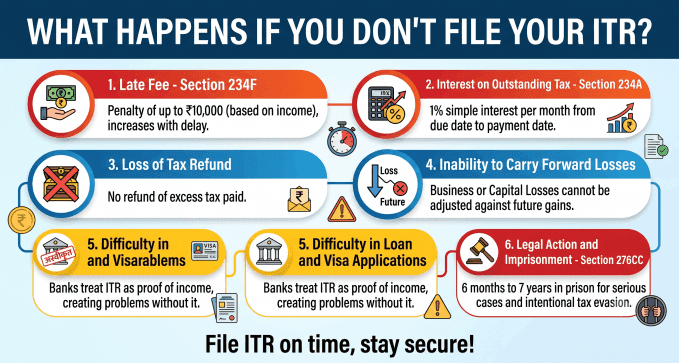
A properly filed ITR helps you claim refunds and avoid penalties or notices. It serves as valid proof of income for loans and visa applications.
Different Types of ITR Forms
ITR Form | Who Should File | Key Conditions |
ITR-1 (Sahaj) | Salaried individuals | Income up to Rs 50 lakh, 1 house property, no capital gains |
ITR-2 | Individuals & HUFs | No business income, but includes capital gains or multiple properties |
ITR-3 | Individuals & HUFs | Income from business or profession |
ITR-4 (Sugam) | Individuals, HUFs, Firms | Presumptive income scheme (Sections 44AD, 44ADA, 44AE) |
ITR-5 | Firms, LLPs, AOPs, BOIs | Non-individual entities |
ITR-6 | Companies | Except those claiming exemption under Section 11 |
ITR-7 | Trusts & Institutions | Charitable, religious, political entities |
Key Deductions
(Mainly applicable under old tax regime)
Deductions are the amounts that the Income Tax Department allows you to reduce your Income, bringing down your tax liability.
Gross income - deductions = Taxable income
Section 80C
Section 80C is one of the most commonly used provisions for tax saving in India, allowing individuals to claim a deduction of up to ₹1.5 lakh per year from their total income under the old tax regime. It covers a wide range of investments and expenses such as PPF, EPF, LIC premiums, ELSS mutual funds, tax-saving fixed deposits, and tuition fees for children. This not only reduces taxable income but also provides long term stability.
Section 80D
It allows a deduction on health insurance premiums paid for self, family, and parents.The deduction is up to Rs.25,000 (Rs.50,000 for senior citizens), with an additional benefit for parents’ insurance. It also includes preventive health check-up expenses (up to Rs.5,000) within the overall limit.
The Income Tax Act provides a wide range of deductions, offering multiple opportunities for taxpayers to optimize their tax liability through effective planning.
Standard Deduction
The standard deduction is a flat deduction available to salaried individuals
Old tax regime: Standard deduction is Rs 50,000
New tax regime: Standard deduction is Rs 75,000
Common Income Tax Mistakes Beginners Make
Not filing ITR assuming TDS is enough
Choosing the wrong tax regime without comparison
Ignoring small income like bank interest
Missing deadlines
Not keeping proper documents
Conclusion
Understanding the basics of income tax in 2026-27 doesn’t require expert knowledge, but your fundamentals should be clear.The real advantage lies in being proactive. You must have an understanding of your income source and you should choose the right tax regime and file your ITR on time.
In practice, those who approach income tax planning early in the year tend to pay less tax and face fewer last-minute hassles. So instead of treating tax as a once-a-year task, consider it a part of your overall financial strategy.