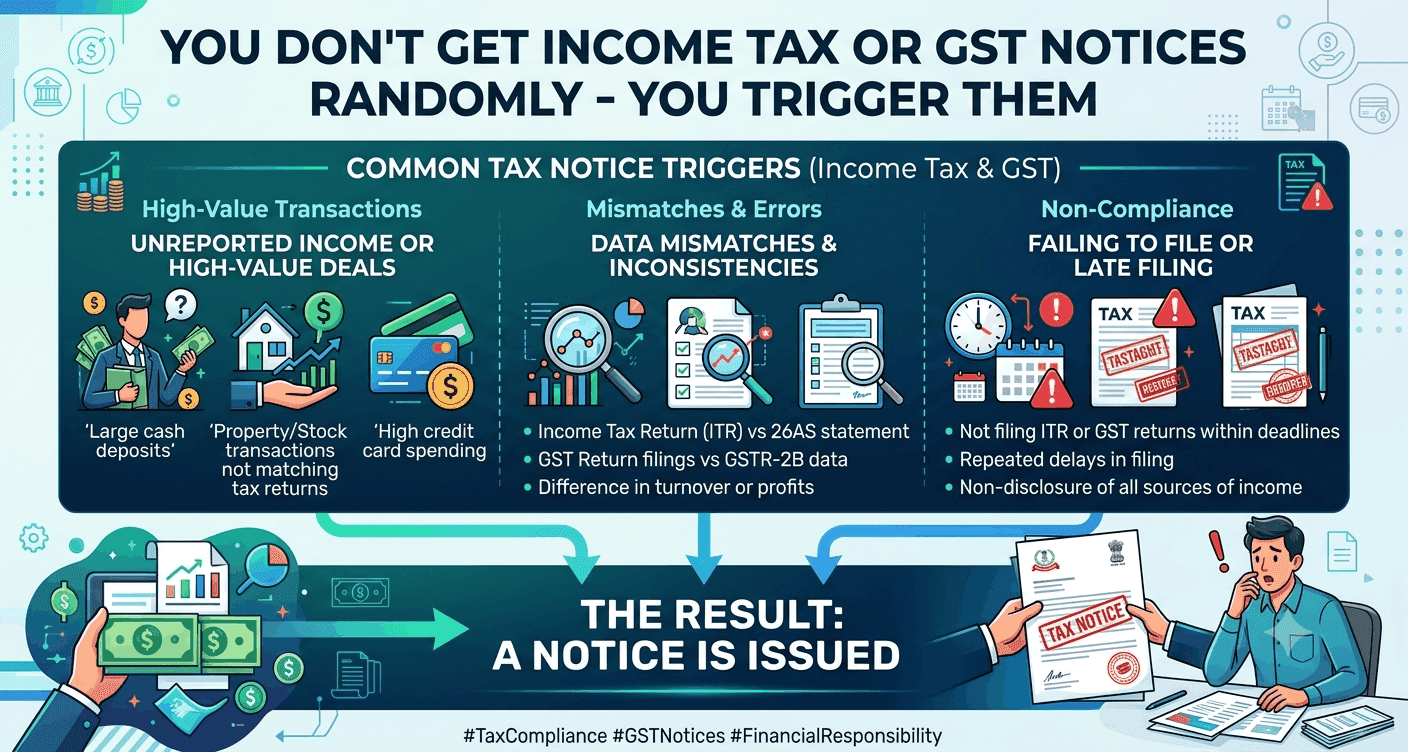
Many business owners and tax payers think that Income tax and GST notices are served randomly. But this is not the reality.
Find the right expert, without the hassle.
Connect with verified professionals for tax, legal, and compliance needs.
In reality most of the notices are triggered by specific mismatches and reporting errors. They are common when the system detects unusual financial patterns. With increasing digitization and data integration, authorities don’t serve notices on guesswork. They can track,compare and flag.
If you have a knowledge of what actually triggers a notice then you can avoid unnecessary stress, penalties, and compliance issues.
How Tax Notices Actually Work in India
If you think that notices are random, it is because of lack of visibility into how the system functions. Today, the Income Tax Department and GST authorities rely heavily on data analytics and AI-based systems. Your PAN is used to track almost all your financial activities. This includes data from banks, the GST portal, TDS filings, and other third-party sources.
As a result of this your income, expenses, investments and GST filings all are connected. They are cross verified. If there is any mismatch or inconsistency in this data, the system doesn’t ignore it. The system gives a signal that something is unusual.And if that issue is not corrected, it can eventually lead to a notice.
What Triggers an Income Tax Notice?
1. Mismatch Between Income and Reported Data
Your reported income is not viewed in isolation. It is compared with multiple data sources. These include TDS returns like Form 26Q and 24Q. It is also matched with Form 26AS and the Annual Information Statement (AIS).
If your ITR shows lower income than what is reported in these records, it creates a mismatch. The system detects this difference quickly. It then flags your return for review. If the gap is significant or unexplained, it can trigger a notice.
For example, you earned Rs. 12 lakhs during the year. But you reported only Rs. 9 lakhs in your ITR. The system identifies this gap. And that is enough to initiate a notice.
2. High-Value Transactions Without Justification
If you enter into certain high value transactions, they are automatically reported to the authorities. These include large cash deposits, property purchases, high credit card spending, and stock market transactions. The system keeps track of these activities through your PAN.
If your declared income does not justify these transactions, it creates a mismatch. This mismatch does not go unnoticed. The system identifies it and raises a flag. If the difference appears significant or unusual, it can trigger a notice asking for an explanation.
3. Incorrect or Inflated Deductions
Proper supporting documentation is required to claim deductions under sections like 80C,80D or HRA.These claims are not accepted blindly. They are checked against your income and financial profile. If your deductions are unusually high compared to your income, it raises suspicion. The system may flag such claims for verification. This is especially true when there is no clear justification or supporting proof. In such cases, it can trigger scrutiny and eventually lead to a notice.
4. Not Filing ITR Despite Taxable Income
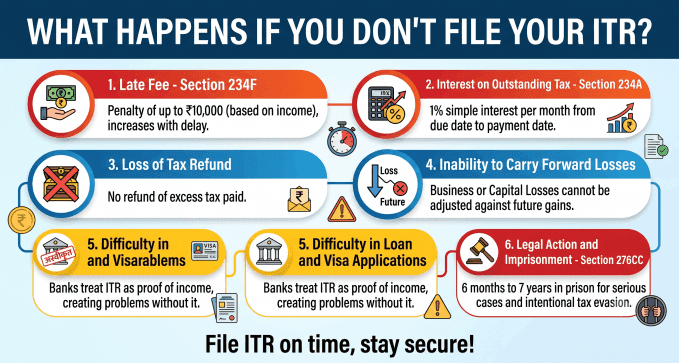
If you have taxable income or you engage in high value transactions. Then you must file ITR. Failure to do the same would be a major red flag for the system.The authorities already have access to your financial data through various sources. It creates a clear mismatch if you don’t file ITR despite having visible income.The system identifies this gap quickly. It then flags the case for non-compliance. If ignored, it can directly lead to a notice asking you to explain why the return was not filed.
5. Frequent Changes or Errors in Returns
If you revise your return repeatedly or file inconsistent data across years, it can lead to notices.
What Triggers a GST Notice?
1. Mismatch Between GSTR-1 and GSTR-3B
GSTR-1 contains detailed sales data while GSTR-3B shows tax summary. Both returns are expected to align with each other. Mismatch between the two is the most common reason for a GST notice. It shows that there is underreporting or incorrect filing. In a case like this notice can be served.
2. ITC Mismatch with GSTR-2B
If you claim ITC (input tax credit) that doesn’t reflect in GSTR-2B, it is a serious issue. GSTR-2B reflects the ITC available based on your suppliers’ filings. If you claim more ITC than what is shown in GSTR-2B, it creates a mismatch. The system treats it as an excess claim.This is a red flag. You may be asked to reverse the ITC with interest. If you ignore it, notice can be served.
3. Sudden Drop or Spike in Turnover
Your current data is always compared with past filings. It may also be compared with industry benchmarks. Unusual changes in turnover can attract attention from the system. This includes sudden increase or decrease in turnover. The system detects these patterns quickly. It then flags the return for further review. If there is no proper explanation, it can lead to scrutiny or a notice.
4. Non-Filing or Late Filing of Returns
GSTR-1 and GSTR-3B are expected to be filed on time every period.Regular delays in filing GST returns can create compliance issues.
5. E-Invoicing and Reporting Errors
Incorrect invoice data can create serious compliance issues. This includes errors in GSTIN, invoice value, or tax amounts. If invoice details are wrong or not reported properly, the system detects it quickly. This raises a flag for non-compliance. If not corrected, it can lead to penalties and a notice.
Practical Tips to Avoid Tax Notices
You must always reconcile before filing. Match your data with AIS, 26AS and GSTR-2B
Don’t ignore small mismatches. Even minor differences can lead to notice if unresolved.
Maintain proper documentation. Keep proper records of deductions, ITC claims and expenses.
Always avoid last minute filing as it increases the chance of errors.
Use reliable accounting systems. Automation reduces manual errors.
Conclusion
You don’t get notices randomly, you trigger them- this is not just a statement but the reality of today’s world.In a world where every financial activity is tracked and matched, accuracy matters more than ever. Notices don’t come because authorities are targeting you.They come because your data tells a different story than your return. But the good news is most of the notices are
avoidable. All it takes is consistency, proper reconciliation and a system driven approach.